An officer tells a homeless woman at Humboldt and Forest that she must move from the encampment.
Councilmember Addison Winslow, at the next City Council meeting, says he will push for a study of Gov. Gavin Newsom’s ordinance designed to guide cities that are struggling to manage homeless encampments.
Last week, Gov. Newsom released what he called a “model ordinance” that can be used to “address unhealthy and dangerous encampments.” The ordinance provides a framework local jurisdictions can use to remove encampments from public spaces, and permits speedier enforcement than the framework the City uses now under the Warren v. ChicoSettlement Agreement.
For example, the so-called model ordinance requires that officials or officers post a notice 48 hours before taking enforcement actions, “except in exigent circumstances involving an imminent threat to life, safety, health, or infrastructure.” In contrast, the Settlement Agreement mandates 7-day notice to Legal Services of Northern California prior to enforcement planning, 7-day notice to homeless persons who are camping on public property, and finally, a 72-hour notice prior to enforcement.read more
Community members who spoke hold out hope for people who seem challenging to help
By Yucheng Tang | Posted May 3, 2025
photo by Yucheng Tang
Behavioral Health Director Scott Kennelly speaks at the first meeting of the City’s ad hoc committee on homelessness.
At the first meeting of the City’s ad hoc committee on homelessness, the discussion touched on the overlap between homelessness, substance abuse and mental health. It also raised two related questions: how to address the problem of shelter-resistant homeless individuals, and whether compelled treatment is sometimes necessary.
Scott Kennelly, the director of Butte County Behavioral Health, said homeless outreach teams have worked to convince unhoused people to take advantage of services and have tried to connect them with services, but there are always people who say, “Leave me the hell alone.”
In his view, homeless people who refuse to go to shelters can generally be divided into three groups: those severely addicted to drugs like Fentanyl and Xylazine who are solely focused on their next hit and refuse any care; those with severe mental illness who are psychotic and unaware of their condition; and those who prefer a rule-free lifestyle.
“There’s almost no one left out there who is not severely addicted to a substance, is severely mentally ill, or has (not) made a lifetime style choice,” Kennelly said.
But Charles Withuhn, president of the North State Shelter Team, said that beyond the categories Kennelly mentioned, there is also a group of people “who will be OK with accountability.” He said he talked to a man who was sleeping in the bushes the other day, and that man told him while crying, “All I need is a door that locks and a little bit of job training, and I will go to work.”
Withuhn, who advocates for smaller programs where homeless people can build and find community, said there are still some unsheltered individuals who want help. “There’s too many people having too many bad experiences in big programs, and they feel like they lose their autonomy.”
Amber Abney-Bass, CEO of the Jesus Center, shared statistics about the people who have been served at the Genesis emergency pallet shelter housing. Since April 2022, 423 people have been served. During 2024, 69% reported having a disability, 33% had a chronic health condition, and 39% reported a mental health disorder, she said. Additionally, 51% said they struggled with addiction, alcohol use or both.
Julian Zener, a community member who was attending the April 30 meeting, asked whether some of the people who seem to be shelter-resistant could be persuaded otherwise, warning against what he called “writing off all the people out there.”
“People who currently turned down offers, you related to three categories that seemed to be sort of irredeemable, and I wonder if there’s part of that fourth category, as Charles suggested, that if we could find out more of their story, and build trust, and they might turn around,” Zener said.
Michael O’Brien, one of three councilmembers on the committee, commented on his impression of the service-resistant population.
“Getting them help is really the challenge,” O’Brien said. “And when you have someone who is not thinking correctly, it’s really difficult to get [something] across to them. You just have to understand how powerful these [drugs] are that are dominating their life.”
The new ad hoc committee is chaired by Mayor Kasey Reynolds, with councilmembers Bryce Goldstein and O’Brien as the other members.
Goldstein asked Kennelly how the underlying issues that are keeping people from accessing services can be addressed.
“You have to pair the treatment and the housing at the same time,” he said.
In terms of treatment, he said he has, over time, shifted his philosophy.
“I’m at a point where I say, ‘You have the opportunity through every possible resource to get help,'” Kennelly said. “You’re not willing or you’re not able to see you need it. Now someone has to come in and help support you like a parent or a big brother or a conservator.”
He mentioned mental health diversion court, drug court, and Stepping Stones Perinatal Program — three programs that can compel or press people to receive treatment — and said he saw the most powerful graduation in Stepping Stones.
Behavioral Health hopes to purchase a motel or hotel in the community to house people who are facing felony charges but have been found incompetent to stand trial, where they can receive support and intensive treatment to restore competency. Such a program would typically last about 18 months, said Kennelly, adding, “At least they won’t be on the streets.”
Kennelly also mentioned that a mental health rehabilitation center will be established this year.
The committee will meet biweekly on Wednesdays from 3-4:30 p.m. until summer, when it will report its findings and recommend action to the full City Council panel. The next meeting is scheduled on May 14 in the city hall conference room.
Yucheng Tang is a California Local News fellow reporting for ChicoSol.
Margo Lemner was one of 18 people who asked City Council for action.
The City Council unanimously passed Mayor Kasey Reynolds’ motion to create an ad hoc committee to address homelessness at the March 4 meeting.
Reynolds noted that “the scope of the committee would be on the three items originally agendized,” including ordinances, code changes and programs distinct from anti-camping ordinance enforcement.
“The committee would have a time-sensitive due date of coming back in one of our June meetings,” Reynolds said, in making the motion for the ad hoc group. “We would bring a report back to Council with recommendations for the full Council to consider at that time.”
Reynolds suggested the committee include herself as chair and councilmembers Bryce Goldstein and Mike O’Brien. Goldstein had asked for the discussion on the trio of items.
Eighteen people spoke during the public comment period, all asking the City for more effective ways to address homelessness, without anyone in opposition.
“I see people in just the last couple of months sleeping on a real piece of sidewalk with no overhead and both night time and storm clouds moving in,” said a speaker from the audience, Margo Lemner. “We need the will, we need outreach, we need more shelter … There isn’t a carpet big enough to sweep all these people under.”
Summer Chapla shared that March 5 was the two-year anniversary of finding her brother in his tent after he overdosed. “I don’t know what the answer is,” Chapla said. “I know that there has to be a better one than what’s going on right now, and we have to treat these people with dignity.”
Councilmember Addison Winslow made a motion to improve utilization of the pallet shelters – the Genesis emergency housing – without impacting the schedule of enforcement sweeps, but the motion failed in a 4-3 vote. Reynolds promised the matter would come before the ad hoc committee.
Reynolds said the pallet shelter housing and the Eaton and Cohasset roads encampment “are having significant issues and impacts on the surrounding businesses and neighborhoods, some of which are close to possibly being legal problems for the City.”
“So I actually agree with a ton of what I heard tonight,” Reynolds said following the public hearing. “Whatever we do needs to work for everybody, our unhoused, our community members, and our businesses.”
Some of the speakers mentioned the Feb. 27 evictions — what the City calls an “enforcement sweep” — at City Plaza. When ChicoSol arrived at the Plaza that morning, some 10 homeless people with tents and luggage were scattered on the sidewalks after being asked to leave and cease camping.
An unhoused man said he had received a seven-day eviction notice on Feb. 19, but he had “so much stuff” he needed to figure out where he could move. “We have nowhere to go,” he told ChicoSol.
One of the speakers at the March 4 meeting protested the sweeps as ineffective in solving the problem.
“As it stands, the sweeps do nothing to help leverage folks out of homelessness who are there,” said Felix Mahootian. “These are just enforcement, not preventive.”
Mayor Reynolds said that according to her “quick math right now” the City might be spending close to $10,000 a year per unhoused person.
Following the meeting Winslow told ChicoSol the proposal for the ad hoc committee was a surprise to him.
“The more we have it in a public light, the better solutions we’re going to get,” Winslow said. “It’s an opportunity to get into some details about how the City has been blocking solutions to homelessness, what the City can do to make smart investments, and improving the outcome.”
President of North State Shelter Team, Charles Withuhn, has campaigned relentlessly for a managed, outdoor campground for unhoused people who don’t accept or can’t get into other shelters.
“It was a historic turn toward a wider variety of plans that offer a more effective shelter crisis strategy by our City Council tonight!” Withuhn wrote in an email to ChicoSol.
Goldstein said she was cautiously optimistic about the new approach.
“I’m grateful to see the Council working together towards addressing homelessness,” she said after the meeting. “It sounds like it’ll probably be me and Michael O’Brien and Kasey Reynolds [on the ad hoc committee]. I look forward to working with them.
“But we have tended to disagree on how to address homelessness,” Goldstein noted. “So I am a little worried that some of the ideas that I may come in there with and that the service providers in our community will want to talk about may get shut down in committee.”
Councilmember Bennett ducks interview opportunity with ChicoSol
By Yucheng Tang | Posted October 11, 2024
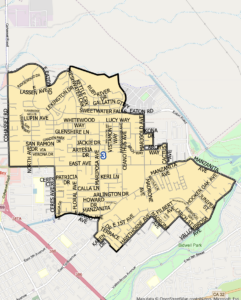
Northeast Chico’s District 3 stretches from a piece of Lower Bidwell Park to the northern border of the City and westward to Cohasset Road.
The District 3 City Council race feels like deja vu to many Chico voters.
Two years ago, Monica McDaniel and Dale Bennett both ran for the District 3 council seat, with McDaniel narrowly losing by about 200 votes. This year, the two are once again competing for the same position.
McDaniel remembers feeling incredibly nervous while waiting for the results and frustrated upon learning she had lost. McDaniel believes this year there could be a different outcome.
ChicoSol interviewed and photographed McDaniel on Oct. 3. Bennett did not respond to requests for an interview that were delivered in emails and phone calls.
Bennett, as an incumbent, emphasized the City’s accomplishments while speaking at the Sept. 17 Chamber of Commerce candidate forum. He seemed proud of the progress he says the City has made on homelessness, affordable housing and in other areas.
Challenger McDaniel told ChicoSol: “When the voters see the word incumbent after his name, they might just go, ‘Let’s just vote for him because we’ve been doing it. Let’s just keep it status quo.’ But I think that public opinion is against what they’re seeing. I think that public opinion is against the bumpy roads, against seeing people illegally camping in the park.
“I’ve got a really good team this time while I was doing it all by myself last time.”
Transparency
One of the criticisms of the current City Council is what some view as a lack of transparency. District 4 Councilmember Addison Winslow told ChicoSol in early September that the council tends to hold too many discussions in closed sessions or direct the mayor to deal with matters privately with City staff.
“There’s no ability to educate the public about why they’re making these decisions or give the public the opportunity to consider alternatives,” Winslow said.
During the Sept. 17 forum, Bennett noted that some discussions were not public in order to comply with a court order.
McDaniel, though, believes there’s an ongoing lack of transparency. “I’ve seen decisions made unilaterally without the collaboration of people. ”
Creating transparency is what she wants to achieve if she gets elected. “The way democracy works is, we’re not supposed to do things without the public being made aware of it, because we allocate money, we make decisions, we do things, and the public needs to be able to weigh in on it,” McDaniel said.
McDaniel wants to create transparency by naming advisory boards and listening to their findings. “Let’s just take fire for instance – the seven members on the council say we have a fire problem, and how are we gonna solve that? Then you can create a subcommittee, and they workshop, they look at it, and then they come back and advise the council and the council makes a decision,” she said. “City Council members cannot just make decisions themselves.”
City Growth
District 3 is primarily a suburban area where, in terms of party preference, Democrats have an edge.
The development and expansion of the City is a hot topic, closely related to how it can provide affordable housing for residents.
First, McDaniel believes that the Green Line, which was designed to be the point of demarcation between urban development and agricultural land on the west side, needs to be preserved, and “the Green Line means that we’re not going to sprawl out and out, and we’re gonna keep our footprint the same way it is.”
McDaniel also said that infill development shouldn’t be the only focus in planning growth.
“I also feel like a lot of the other liberal candidates say that they want infill and high density,” she said. “I agree with the high density, but I also think we need single family homes for young families.”
She continued, “It’s like what we called the American Dream, to own your own home. When you pay rent over and over again, the money goes to someone else, but when you own a home, you’re investing in your future.”
McDaniel said it’s more common for young people to choose to rent, but, “I think after the young families have kids, they will want a longer-term investment instead of a more transitory renting option. I know there’s something really cool about owning your own home.”
Bennett, her opponent, said during the Sept. 17 forum that the City Council has done a lot to support the development of affordable housing. But he also said: “We need to have an inventory of all types of housing. Affordable (housing), three-bedroom with two bathrooms and an attached garage … We need it all. We’re way behind.”
On Bennett’s campaign website, he wrote: “As a Chico native, I want Chico to continue to grow, without losing that charm which makes it special.”
Bennett said the City needs to support those entities, those businesses and those developers who will come into Chico and create affordable housing. “Valley’s Edge was a great project, a great project,” Bennett said of his support for the housing development that was rejected in a referendum.
On McDaniel’s website, she wrote: “The Valley’s Edge plan faced compelling opposition from the public and the Council majority not only approved the development but did so with no work addressing concerns and no conditions of approval. This has been a pattern of their decision-making.”
Homelessness
Homelessness is an important issue for District 3 as well. Although the City-sanctioned Cohasset and Eaton roads encampment is just outside the district, people who live in this area still encounter many unhoused people.
A 47-year-old man wearing a black MAGA cap, encountered in a grocery parking lot, said he’s most worried about homelessness. “I want our parks back. I want our clean waterways back,” he said. “We don’t owe them. Why do we need to give them washers and dryers? My taxes could have been used better.”
When asked for a possible solution, he said “Just let them go somewhere else.”
He complained that many of the unhoused people are young, rather than those who are not able to work like the elderly or disabled.
Another District 3 resident, Gail Mandaville, who is also McDaniel’s campaign manager, said it is a more complicated issue than people think.
“You cannot tell if a person is disabled or unhealthy by looking at them. That’s what people are doing. They don’t know much about mental health.” She thinks that many equate the homeless with “bad people” who are on drugs. But many unsheltered individuals cannot manage their lives and they need help.
Both Bennett and McDaniel think that camping in public areas is illegal and those camps should be cleared. McDaniel says on her website that she supports a plan to set a firm line against camping in parks, paths, and near schools.
But McDaniel differs from Bennett in some ways. McDaniel argues that before clearing the encampments, the City should provide some suitable options for sheltering homeless individuals. She believes there should be managed campgrounds.
Bennett wrote on his campaign website: “We must not allow illegal encampments to establish in our public spaces creating fire risk, environmental damage, and crime in our neighborhoods when there are shelter beds available.”
During the Sept. 19 forum, Bennett said: “We’re still struggling with what to do about those who are resistant to help. There needs to be a compassionate, yet effective way to address this. I don’t know anybody that has the silver bullet.”
McDaniel shared her opinions about shelter-resistant unhoused people at the same forum: “There needs to be something more. There needs to be better outreach. There needs to be better options available that can give individuals the opportunity to take responsibility for their own care and to be part of their own healing.”
Yucheng Tang is a California Local News Fellow reporting for ChicoSol. Read his District 1 race story here.
City threat to shut down intake threatens winter sheltering program
By Leslie Layton | Posted January 4, 2024
photo by Leslie Layton
Safe Space’s shuttle takes clients to a local church where they can sleep for the night.
Jan. 6 update: Chico City Council held an emergency meeting today after Safe Space was forced to move intake from the downtown building. (Intake today will be held at 5:30 p.m. at 285 East 5th St.) A meeting will be held Tuesday between City and Safe Space managements, and Council members Sean Morgan and Addison Winslow.
Safe Space Executive Director Hilary Crosby was encouraged today by City officials who she said have agreed to meet to discuss the intake center problem that has threatened to shut down Chico’s emergency winter sheltering program.
In a Dec. 21 letter from Community Development Director Brandon Vieg, the City denies the request from Safe Space for a zoning verification that would allow it to continue operating intake at 101 Main St., the site of the former 7-Eleven store.
Crosby said today she expects a meeting to take place next week and expects that Safe Space may have to find another location. “I don’t anticipate them trying to shut us down in the meantime,” she said.
Safe Space, which houses 60 homeless individuals nightly at a collaborating church, believes it should be allowed temporary use of the downtown location under a City code designed for emergency public health purposes.
But Vieg, in the City’s denial letter, states: “An emergency is an urgent, sudden, and serious event or an unforeseen change in circumstances … While the City has declared a shelter crisis, this crisis has been in place for over 5 years and is ongoing.”
The issue began with a Dec. 19 Notice of Municipal Code Violation ordering Safe Space to immediately cease use of the building on grounds that the program lacked zoning clearance and there had been a citizen complaint.
Safe Space receives City funding for its seasonal sheltering program, and City leaders have been swamped with letters from residents protesting its action.
Crosby said program leadership believed it could run intake at the site, which makes it a meeting point for people waiting for the shuttle to a church. Intake would be ongoing nightly from 5 p.m. to 8 p.m. until March 3. “We’re definitely saving people’s lives,” she said. “Without supportive services [unhoused] people would be super vulnerable out there.”
The winter sheltering program has a maximum capacity of 60 and has been turning away people nightly to avoid exceeding that number. About 60 percent of Safe Space clients have a self-reported disability, Crosby said.
Butte County Shelter for All has compiled a list of 27 unhoused people who died, usually on Chico streets, in 2023. That list includes Jason Merced, who had been recently interviewed for stories here and here and whose body was found Nov. 20 at Fifth and Main streets.
Safe Space needs more donated blankets, sleeping bags and tarps, and requests that those or other donated items be left at its office at 1907 Mangrove Ave., suite E.
Read ChicoSol’s story on how the unhoused develop survival strategies here, our report on the success of the pallet shelter program here, and our story on the violence targeting people living on the streets here.
Campers believe the hole was caused by gunfire aimed at them.
Sidebar to part II in ChicoSol series on homelessness in 2023.
On a Friday morning in September, North State Shelter Team (NSST) volunteers keep the mobile shower unit running during their weekly visit to the alternate site campground. Hope Commons Church has brought coffee and rolls for unhoused campers. Suddenly, a ping ping ping interrupts quiet conversations.
Then, a tide of irritation and indignant anger rolls through the encampment with the realization that there has just been a BB gun shooting aimed at the group from a passing car. No one was hit, but any of us – from the unhoused to the community volunteers to a pair of ChicoSol journalists on assignment – could have been.
Witnesses near the gate saw a purple-ish Nissan speeding west on Eaton Road. Several volunteers call the police, and soon after Chico Police Department would leave a message to report that it couldn’t locate the car.
The site is about 2 acres surrounded by a chain link fence that’s covered by a green screen. A gate stands open. The land is bumpy flat with only a few struggling, scrawny young trees. About 25 people live here in tents or under tarps that appear jumbled, erected without organization. The campers are referred here after assessments if they’re not referred to a pallet or congregate shelter.
There is a single water spigot, but no sink or installed bathing facility.
At the time of my ChicoSol visit, the site was littered with old furniture, tires and other items in heaps. There is something about this place that shocks; this is, after all, Chico, where I don’t expect to see slum-like living at Eaton and Cohasset roads.
Since then, NSST volunteers have organized resident meetings and undertaken dump runs to clean up the site.
Unhoused residents say BB gun shootings aimed at them were common during the campground’s first year of operation, but this shooting — the one that I just witnessed — might have been the first in broad daylight.
Camper Chris Y., who declines to be fully identified, says that during one period last year “they were coming every night.” On one occasion — about midnight toward the end of the summer — he was struck by BBs in the left shoulder.
“It hurt like hell,” he says. “I could have lost a damn eye. It sucks, man. There are people out there who would like to line us up in a firing squad and take us out. I get why they hate us –- there’s been some vandalism by the homeless -– but not everyone’s a piece of shit. We do get targeted.”
Robert Wetzel, another camper, seems less irate and more saddened by their relationship with the community. “We’re treated like animals, like a stray zoo,” he said. “People drive by and point at us and show their children. They drive by and shout at us, ‘Get a job, get out of California.’ They want us out of eyesight, that’s what the city wants.”
Wetzel says he often wishes that the group could put on a barbecue and invite members of the larger community. “When you break bread with someone you get to know them,” he says.
NSST founder Charles Withuhn says the single dumpster and weekly garbage pickup provided by the City aren’t enough for the site. To make matters worse, he says he’s twice seen people drive by and dump mattresses or other used items they wanted to discard. “A real fancy pickup backs in and pushes out a couch and drives off,” he says.
A couple of weeks earlier, campers say that someone threw a pipe bomb over the fence late one night. And when ChicoSol returned to the campground in October, residents said there were holes in the green screen that they believe were caused by bullets fired in a 3 a.m. shooting.
Wetzel heard the shooting but didn’t call police. “They’re not really on our side,” he says. “I’ve called before and it went against me.”
In an amicus brief filed by the City to support a judicial review of court rulings related to homelessness, the City discusses, in many of the 48 pages, the impact encampments have had on neighborhoods that have suffered property damage and theft, and on strained police, fire and public safety services. In the “Acts of Violence” section, it lists incidents between unhoused people that required a police response and incidents provoked by residents of encampments.
It does not discuss acts of violence against encampments that were allegedly perpetrated by members of the larger community — with the exception of the 2022 Teichert Ponds shooting.
Some people shoot at this group of people. Others come with a shower unit or warm coffee. It’s that chasm between reactions from those of us in the larger community, between kindness and violence, that startles me most.— Leslie Layton