photo by Karen Laslo A beautiful basket of flowers
Chip Chao The overnight strikes, killing at least 12, further underscored how months of diplomacy aimed at brokering a cease-fire have failed to yield a the strawberry farmer sells juicy and sweet strawberries from March to July.
An officer tells a homeless woman at Humboldt and Forest that she must move from the encampment.
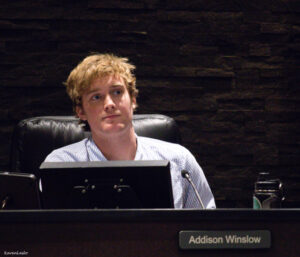
Councilmember Addison Winslow, at the next City Council meeting, says he will push for a study of Gov. Gavin Newsom’s ordinance designed to guide cities that are struggling to manage homeless encampments.
Last week, Gov. Newsom released what he called a “model ordinance” that can be used to “address unhealthy and dangerous encampments.” The ordinance provides a framework local jurisdictions can use to remove encampments from public spaces, and permits speedier enforcement than the framework the City uses now under the Warren v. ChicoSettlement Agreement.
For example, the so-called model ordinance requires that officials or officers post a notice 48 hours before taking enforcement actions, “except in exigent circumstances involving an imminent threat to life, safety, health, or infrastructure.” In contrast, the Settlement Agreement mandates 7-day notice to Legal Services of Northern California prior to enforcement planning, 7-day notice to homeless persons who are camping on public property, and finally, a 72-hour notice prior to enforcement.read more
Community members who spoke hold out hope for people who seem challenging to help
By Yucheng Tang | Posted May 3, 2025
photo by Yucheng Tang
Behavioral Health Director Scott Kennelly speaks at the first meeting of the City’s ad hoc committee on homelessness.
At the first meeting of the City’s ad hoc committee on homelessness, the discussion touched on the overlap between homelessness, substance abuse and mental health. It also raised two related questions: how to address the problem of shelter-resistant homeless individuals, and whether compelled treatment is sometimes necessary.
Scott Kennelly, the director of Butte County Behavioral Health, said homeless outreach teams have worked to convince unhoused people to take advantage of services and have tried to connect them with services, but there are always people who say, “Leave me the hell alone.”
In his view, homeless people who refuse to go to shelters can generally be divided into three groups: those severely addicted to drugs like Fentanyl and Xylazine who are solely focused on their next hit and refuse any care; those with severe mental illness who are psychotic and unaware of their condition; and those who prefer a rule-free lifestyle.
“There’s almost no one left out there who is not severely addicted to a substance, is severely mentally ill, or has (not) made a lifetime style choice,” Kennelly said.
But Charles Withuhn, president of the North State Shelter Team, said that beyond the categories Kennelly mentioned, there is also a group of people “who will be OK with accountability.” He said he talked to a man who was sleeping in the bushes the other day, and that man told him while crying, “All I need is a door that locks and a little bit of job training, and I will go to work.”
Withuhn, who advocates for smaller programs where homeless people can build and find community, said there are still some unsheltered individuals who want help. “There’s too many people having too many bad experiences in big programs, and they feel like they lose their autonomy.”
Amber Abney-Bass, CEO of the Jesus Center, shared statistics about the people who have been served at the Genesis emergency pallet shelter housing. Since April 2022, 423 people have been served. During 2024, 69% reported having a disability, 33% had a chronic health condition, and 39% reported a mental health disorder, she said. Additionally, 51% said they struggled with addiction, alcohol use or both.
Julian Zener, a community member who was attending the April 30 meeting, asked whether some of the people who seem to be shelter-resistant could be persuaded otherwise, warning against what he called “writing off all the people out there.”
“People who currently turned down offers, you related to three categories that seemed to be sort of irredeemable, and I wonder if there’s part of that fourth category, as Charles suggested, that if we could find out more of their story, and build trust, and they might turn around,” Zener said.
Michael O’Brien, one of three councilmembers on the committee, commented on his impression of the service-resistant population.
“Getting them help is really the challenge,” O’Brien said. “And when you have someone who is not thinking correctly, it’s really difficult to get [something] across to them. You just have to understand how powerful these [drugs] are that are dominating their life.”
The new ad hoc committee is chaired by Mayor Kasey Reynolds, with councilmembers Bryce Goldstein and O’Brien as the other members.
Goldstein asked Kennelly how the underlying issues that are keeping people from accessing services can be addressed.
“You have to pair the treatment and the housing at the same time,” he said.
In terms of treatment, he said he has, over time, shifted his philosophy.
“I’m at a point where I say, ‘You have the opportunity through every possible resource to get help,'” Kennelly said. “You’re not willing or you’re not able to see you need it. Now someone has to come in and help support you like a parent or a big brother or a conservator.”
He mentioned mental health diversion court, drug court, and Stepping Stones Perinatal Program — three programs that can compel or press people to receive treatment — and said he saw the most powerful graduation in Stepping Stones.
Behavioral Health hopes to purchase a motel or hotel in the community to house people who are facing felony charges but have been found incompetent to stand trial, where they can receive support and intensive treatment to restore competency. Such a program would typically last about 18 months, said Kennelly, adding, “At least they won’t be on the streets.”
Kennelly also mentioned that a mental health rehabilitation center will be established this year.
The committee will meet biweekly on Wednesdays from 3-4:30 p.m. until summer, when it will report its findings and recommend action to the full City Council panel. The next meeting is scheduled on May 14 in the city hall conference room.
Yucheng Tang is a California Local News fellow reporting for ChicoSol.
Margo Lemner was one of 18 people who asked City Council for action.
The City Council unanimously passed Mayor Kasey Reynolds’ motion to create an ad hoc committee to address homelessness at the March 4 meeting.
Reynolds noted that “the scope of the committee would be on the three items originally agendized,” including ordinances, code changes and programs distinct from anti-camping ordinance enforcement.
“The committee would have a time-sensitive due date of coming back in one of our June meetings,” Reynolds said, in making the motion for the ad hoc group. “We would bring a report back to Council with recommendations for the full Council to consider at that time.”
Reynolds suggested the committee include herself as chair and councilmembers Bryce Goldstein and Mike O’Brien. Goldstein had asked for the discussion on the trio of items.
Eighteen people spoke during the public comment period, all asking the City for more effective ways to address homelessness, without anyone in opposition.
“I see people in just the last couple of months sleeping on a real piece of sidewalk with no overhead and both night time and storm clouds moving in,” said a speaker from the audience, Margo Lemner. “We need the will, we need outreach, we need more shelter … There isn’t a carpet big enough to sweep all these people under.”
Summer Chapla shared that March 5 was the two-year anniversary of finding her brother in his tent after he overdosed. “I don’t know what the answer is,” Chapla said. “I know that there has to be a better one than what’s going on right now, and we have to treat these people with dignity.”
Councilmember Addison Winslow made a motion to improve utilization of the pallet shelters – the Genesis emergency housing – without impacting the schedule of enforcement sweeps, but the motion failed in a 4-3 vote. Reynolds promised the matter would come before the ad hoc committee.
Reynolds said the pallet shelter housing and the Eaton and Cohasset roads encampment “are having significant issues and impacts on the surrounding businesses and neighborhoods, some of which are close to possibly being legal problems for the City.”
“So I actually agree with a ton of what I heard tonight,” Reynolds said following the public hearing. “Whatever we do needs to work for everybody, our unhoused, our community members, and our businesses.”
Some of the speakers mentioned the Feb. 27 evictions — what the City calls an “enforcement sweep” — at City Plaza. When ChicoSol arrived at the Plaza that morning, some 10 homeless people with tents and luggage were scattered on the sidewalks after being asked to leave and cease camping.
An unhoused man said he had received a seven-day eviction notice on Feb. 19, but he had “so much stuff” he needed to figure out where he could move. “We have nowhere to go,” he told ChicoSol.
One of the speakers at the March 4 meeting protested the sweeps as ineffective in solving the problem.
“As it stands, the sweeps do nothing to help leverage folks out of homelessness who are there,” said Felix Mahootian. “These are just enforcement, not preventive.”
Mayor Reynolds said that according to her “quick math right now” the City might be spending close to $10,000 a year per unhoused person.
Following the meeting Winslow told ChicoSol the proposal for the ad hoc committee was a surprise to him.
“The more we have it in a public light, the better solutions we’re going to get,” Winslow said. “It’s an opportunity to get into some details about how the City has been blocking solutions to homelessness, what the City can do to make smart investments, and improving the outcome.”
President of North State Shelter Team, Charles Withuhn, has campaigned relentlessly for a managed, outdoor campground for unhoused people who don’t accept or can’t get into other shelters.
“It was a historic turn toward a wider variety of plans that offer a more effective shelter crisis strategy by our City Council tonight!” Withuhn wrote in an email to ChicoSol.
Goldstein said she was cautiously optimistic about the new approach.
“I’m grateful to see the Council working together towards addressing homelessness,” she said after the meeting. “It sounds like it’ll probably be me and Michael O’Brien and Kasey Reynolds [on the ad hoc committee]. I look forward to working with them.
“But we have tended to disagree on how to address homelessness,” Goldstein noted. “So I am a little worried that some of the ideas that I may come in there with and that the service providers in our community will want to talk about may get shut down in committee.”
Councilmember Addison Winslow complained at the Feb. 18 City Council meeting that there were “cockamamie” procedural objections that blocked his effort earlier this year to ensure there will be future discussion on redistricting and how it’s done.
“I wanna believe that this is the last time that we have an issue like that,” Winslow said from the dais during the public comments section of the meeting. “I think the least that we can do is maintain a legitimate public decision-making process.”
Newly-elected Councilmember Bryce Goldstein, at the Jan. 28 meeting, made the motion to direct staff to return with information regarding the application of several reforms, including the possible establishment of an independent redistricting commission.
After Goldstein’s motion for electoral reform failed on a 4-3 vote at that meeting, Winslow moved to table discussion on an independent redistricting commission to September 2028. That effort was met with objections from both Mayor Kasey Reynolds and Councilmember Tom van Overbeek.
“I don’t think we can do a follow-up motion,” Reynolds said. “Can we do two motions on one item?” she asked, turning to the city clerk and city attorney.
City Attorney John Lam indicated that the motion should be disqualified. He said at the meeting that Winslow’s motion was “an attempt to try to reopen that discussion on that failed motion.”
Redistricting is the process of redrawing election district lines so that each district is “substantially equal in population.” Redistricting is undertaken every 10 years in connection with new data from the U.S. Census. The FAIR MAPS Act states that “boundaries shall not be drawn for purposes of favoring or discriminating against a political party.”
“We saw in the first and second processes in Chico, two different political majorities on the City Council, who, in some opinions, kind of drew district lines in favor of themselves,” Goldstein said at the January meeting, noting that both liberals and conservatives have been accused of manipulating district boundaries to their advantage.
Winslow said he later consulted experts in municipal law who said the disqualification was “absolutely wrong” because his and Goldstein’s motions “would have produced a totally different outcome.”
“This is ridiculous that you can’t have multiple motions on an item,” he told ChicoSol in a phone interview.
Lam acknowledged in a follow-up email to Winslow that “a motion that is substantially different from the failed motion could be made.”
Lam also responded to ChicoSol questions in a Feb. 21 email, indicating he has reconsidered and reversed his position.
“Following the January 28th, I’ve had the benefit of reviewing the council meeting video and determined my initial understanding of the motion was inaccurate,” he wrote. Lam noted that his initial understanding was that the motion made by Winslow would constitute a “Motion to Reconsider,” which in fact has quite restricted use.
Winslow said he has considered bringing the motion back at some point before the next census. “Maybe in a year, we’ll try to bring it back again,” he told ChicoSol. “Probably closer to the (2026) election is a more sensible time when people are watching Council actions more.
“We need to get a fourth vote in order to have a discussion again in order to make that motion to table it again. It puts us several steps away,” he added.
Winslow pointed out that redistricting can determine the political majority of the Council because of the ways in which voters are grouped in the City’s seven districts. Winslow said he decided to speak during the public comment time at the most recent meeting because, “to a certain extent, the public, too, should be aware of how our rules work.”
Yucheng Tang is a California Local News fellow reporting for ChicoSol.
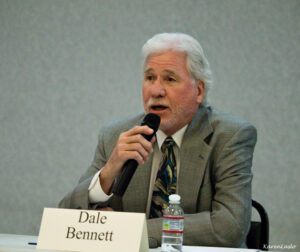
Incumbent Dale Bennett has retained the District 3 seat, defeating challenger Monica McDaniel by only 93 votes in the closest race in the 2024 Chico City Council election.
The majority of the City Council remains conservative, but the number of progressive councilmembers has increased from one to three. A special meeting of the City Council will be held at 6 p.m. Dec. 4 in the Council Chamber at 421 Main St. Newly-elected councilmembers will be sworn in and the mayor and vice mayor selected.
The Butte County Clerk’s office released the official results of the Nov. 5 General Election this morning, with County Clerk and Registrar of Voters Keaton Denlay certifying the election result.
Former Police Chief Michael O’Brien won the District 1 race against Mike Johnson with about a 10 percent margin. In District 5, Katie Hawley secured a clear victory over Melissa Lopez-Mora. Bryce Goldstein won the District 7 race, unseating incumbent Deepika Tandon.
The winners – O’Brien, Bennett, Hawley and Goldstein – will serve on the City Council alongside councilmembers Kasey Reynolds (District 2), Addison Winslow (District 4), and Tom van Overbeek (District 6).
The progressive slate — Winslow, Goldstein and Hawley — are all under 30 years old.
“I feel like the reason I felt empowered to run was because I saw someone else who was younger running – Addison,” Hawley said. “I’ve been very vocal about how he had some influence on my decision.”
Goldstein thinks the three of them can bring diverse perspectives to the council.
“We’ve had a lot of people from older generations serving. We have people who are retired, people who have kids, people who are middle aged,” Goldstein said. “We bring a perspective to the council, not just from our age, but also as people who are renters, people who can sympathize with half of our city’s population, who rent their homes and have to deal with things like annual price increases that are more than their wage increase.”
Goldstein told ChicoSol she was glad she and Hawley won, but also expressed frustration over McDaniel’s loss.
“To me, balance on the City Council would look like people on the left, people on the right, and moderates,” Goldstein said. “And I think Monica would have brought a really good, moderate voice to the City Council, being able to work with both sides.”
“I’m worried that with the conservatives still in the majority, my ideas for how we should make progress in our community are all going to be an uphill battle,” she added.
Opportunities for progress
Goldstein hopes to create low-barrier shelters and managed campgrounds in collaboration with organizations like Safe Space and other shelter providers, but worries that it will be difficult to win majority support.
“When it comes to things like homelessness, I’m afraid that we’re going to disagree too much and not be able to make enough progress on an issue that’s really impacting our community.”
But Goldstein also sees opportunities for collaborating with conservatives on some of the more nonpartisan issues, like “improving our streets, improving walking and biking safety, improving the way that we grow as a community, such as by creating remarkable mixed-use corridors, revitalizing downtown and Park Avenue.”
Goldstein said she wants to establish an independent redistricting commission during her term.
“I just experienced running for council in a district that is so weirdly shaped that so many people don’t even know they’re in [the district],” Goldstein said. “It impacted the voters in my community and their voice was being diluted. I want our city to have districts that keep communities together.”
Goldstein criticized past redistricting practices by both liberals and conservatives, which she believes harmed local democracy. She plans to initiate the process to form a redistricting commission “that doesn’t just benefit Republicans or Democrats” before the 2030 census.
Hawley worries that rent stabilization for mobile home parks may be difficult to achieve. But she hopes to provide more small-scale managed shelters, and to make that happen her strategy would be to propose opening such a shelter in her own district first. “Maybe offering up my own district space for that would be more of an incentive for other counselors to be okay with it,” she said.
“I wouldn’t mind being one of the first districts to say, ‘Let’s try it out on a smaller scale somewhere in our district.’ Maybe Orange Street could be considered for that. But something small, just like maybe 10 to 20 shelter beds. I think it would be an incremental small step.”
Dale Bennett was unable to comment by ChicoSol’s deadline today and Michael O’Brien could not be reached.
Yucheng Tang is a California Local News Fellow reporting for ChicoSol.