

About 70 people, including students from Chico State and Butte College and a few faculty members and Chico residents, gathered in front of Kendall Hall today to call for a ceasefire and to remember journalists and other civilians killed in Israel’s bombing of Gaza. Chico State’s Academic Senate will hold a special meeting May 7 to vote on whether to agendize discussion on a ceasefire resolution, and ChicoSol will post a story after. (Photo by Karen Laslo.)
Chico PD holds its first town hall
Homelessness, de-escalation and diversity discussed
photo by Leslie Layton
Chief Billy Aldridge at Chico PD’s first town hall.
In the first of two town halls to be held this year, Chico police addressed topics that emerged from the recent Community Survey as concerns, including homelessness and the department’s use of de-escalation techniques.
The May 1 town hall followed the recent release of results from the department’s Community Survey that received 797 responses from Chico-area residents. Most of the respondents were over 50 years old and a disproportionate number white. Almost 60 percent said the unhoused community was a major concern.
The new Police Community Advisory Board and Chief Billy Aldridge sat in a row facing an audience of about 20 people. Both the chief and board Chair Roger Efremsky said the public needs to better understand that officers can only remove pop-up homeless encampments under the parameters set by the Warren v. Chico lawsuit settlement.
Chico PD works to improve image, community relations
Police reform advocates call for policy changes
photo by Karen Laslo
Chicoans at a protest several years ago.
The Chico Police Department, after facing years of scrutiny over transparency and accountability concerns, has launched an effort to improve its community image.
Chico PD’s administration has within the last six months jump-started several efforts to improve its public image, announcing today the results of its Community Survey, which can be found here.
Chief Billy Aldridge, who assumed leadership in December 2022, has re-organized the department’s Police Community Advisory Board (PCAB) that the City says is “working to enhance communication and transparency.” The board’s formation follows years of pressure from community members who want improvement in the public’s ability to air concerns and grievances.
Connecting farmworkers to healthcare in California’s rural north
Glenn & Butte counties included in effort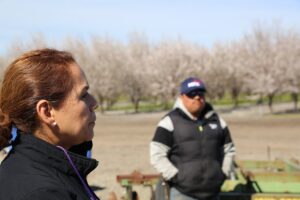
Leer en espańol aqui
HAMILTON CITY – It’s late February and the road to Hamilton City about 10 miles west of Chico is lined with blooming almond trees, their pink blossoms blanketing the fields for miles around. A single clinic stands in the center of town.
Inside the clinic we meet Maria Soto, whose work as a promotora is an essential piece in California’s ambitious plan to deliver healthcare to all residents regardless of immigration status.
“I identify very much with the community,” says Soto, 57. “I worked in the fields, harvesting and sorting nuts here. So, I love it. It gives me a lot of satisfaction when someone says, ‘Thank you for helping me.’ This for me is invaluable.”
University Farm director brings global perspective
Orellana's priorities: water, technology, community engagement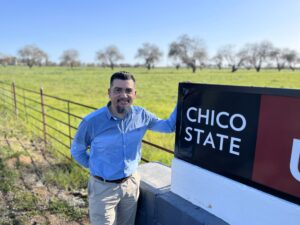
photo by Ken Smith
Ricardo Orellana brings a global perspective to his role as the Chico State University farm director.
Ricardo Orellana grew up against the backdrop of a 12-year civil war in his native El Salvador, but his childhood memories are thankfully dominated by more peaceful recollections — namely, of working with the cows at his grandmother’s farm outside the small town of Usulutá.
“It wasn’t a large farm, just five or six acres with about 25 milking cows and a few other animals,” Orellana said during a recent interview. “She also grew cassavas, tomatoes, beans and corn. It was very rural, and how I fell in love with agriculture.”
In the ensuing decades, that passion has carried Orellana around the world, and most recently to Chico. Orellana was hired as the director of the Chico State University Farm last year, and this month will celebrate one year serving in that capacity. He is the first person of color and the first native Spanish speaker to hold that job, and brings a unique international perspective to the position.
A detour to the Cesar Chavez monument
At the southern tip of Highway 99
photo by Lindajoy Fenley
The gravesites of Cesar and Helen Chavez.
Editor’s note: ChicoSol is reviving its Highway 99 series that was popular some 10 years ago to mark this year’s Cesar Chavez Day. State Route 99 cuts through California’s Central Valley, where union organizing had a tremendous impact.
by Lindajoy Fenley
posted March 27
The final resting place of Cesar Chavez, who led strikes to improve the lot of underpaid and disrespected farmworkers nationwide more than 50 years ago, has the peaceful moniker Nuestra Seńora Reina de la Paz.
It has been headquarters of Chavez’s United Farm Workers union (UFW) since 1972 and a National Monument where the labor leader’s March 31 birthday has been celebrated annually since 2010. A warning sign that entry to the area is “impassable during high water” serves as a metaphor that the struggle for farmworker rights still faces challenges. Indeed, the bucolic spot tucked into the hills 30 miles east of Highway 99, a few miles before it merges into Interstate 5, is not immune from the controversy that marked Chavez’s life.