Waddell honored for police shooting, Sites stories
By ChicoSol staff | Posted April 1, 2020
photo courtesy of Sites Project Authority
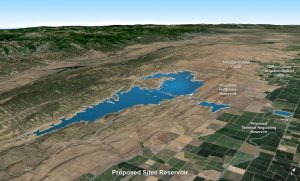
A conceptual rendering of the Sites reservoir west of Maxwell. Dave Waddell’s first-place story was supported by an Ethnic Media Services fellowship.
ChicoSol contributor Dave Waddell has won four honors, including two first-place awards, and ChicoSol Editor Leslie Layton was named a second-place winner in the 2019 California Journalism Awards competition.
The results were announced Tuesday by the sponsoring California News Publishers Association, which cancelled its planned spring awards gala because of coronavirus risks.
Waddell captured top honors in the in-depth reporting category for a series of stories on law enforcement killings in Butte County. He also placed first in land-use reporting for an extensive story on the proposed Sites reservoir.read more
Foes say $5 billion project to severely degrade water quality
By Dave Waddell | Posted May 28, 2019
photo courtesy of Sites Project Authority
A conceptual rendering of the Sites reservoir west of Maxwell.
James Murphy’s ranchland, which he’s owned for 35 years, would be under water if the long-discussed Sites reservoir becomes a reality.
If the Sites Project Authority seeks to acquire Murphy’s property to build the reservoir, he’s going to make it as difficult for them as possible.
“I don’t want to sell my land; there’s no reason for me to sell,” said Murphy, a retired rancher who leases his 1,600 Sites-area acres for cattle grazing. “If they condemn it, they’ll have to tear it out of my hands.”
The proposed reservoir is being promoted as means of capturing water in big storms for use during California’s inevitable dry stretches. Sites’ timeline has the project being reviewed by the California Water Commission in 2021 and becoming operational in 2029.read more
Beyond the staggering human losses in last month’s devastating Camp Fire, another potential loser from the inferno’s toxic runoff are Butte Creek’s highly valued Chinook salmon during a particularly vulnerable time in their lifecycle.
Whether and to what extent that spring-run salmon population is poisoned by a potential witches’ brew of toxins flowing from the extremely hot wildfire won’t truly be known for about three years. That’s when most of the surviving salmon that today are juveniles are due to return from the Pacific Ocean to spawn and die in Butte Creek.
The Camp Fire, which started Nov. 8, quickly became a mega-blaze that sprinted and sprawled through and beyond the Butte County communities of Paradise, Magalia and Concow. At least 86 people were killed and nearly 27,000 displaced in what became the deadliest wildfire in California history. The fire stormed through more than 150,000 acres and destroyed nearly 14,000 homes and in excess of 500 commercial structures.read more
Environmental group says raising dam would swamp thousands of acres
By Dave Waddell | Posted June 28, 2018
photo courtesy of California Department of Water Resources
Hillside erosion around Lake Shasta in a drought year
A decades-old plan to raise Shasta Dam – resuscitated by the Trump administration — would not only flood what little remain of the Winnemem Wintu’s sacred tribal lands but more broadly denude “thousands of acres” of forested watershed above Lake Shasta.
The estimate of forest area to be inundated is from AquAlliance, a Chico-based environmental group. AquAlliance contends that a higher dam would drown riparian plant and animal life around Lake Shasta, leaving more hillsides naked and more sediment eroding to the bottom of the reservoir.
Media attention to date has largely focused on what raising 602-foot Shasta Dam by 18 1/2 feet would do to the scenic McCloud River, a trout-fishing oasis revered by the Winnemem and protected against dam building by California law.read more
Protesters in Sacramento, part of a new generation of climate activists helping to redefine mainstream environmentalism in California.
Photo via Flickr
Almost thirty years ago East Los Angeles resident and mother of nine kids, Juana Gutierrez, took on an oil giant and won. Hailed at the time in national and international media, Gutierrez was seen as being in the vanguard of a “fledgling” environmental movement, one deeply rooted in California’s expanding communities of color. (Lea esta nota en ingles aqui.)
Today that fledgling movement has blossomed into what is fast becoming the new mainstream of environmental activism in the state.
“Things have obviously changed, not just in the last couple of years but over a number of years,” says Bruce Saito, head of the California Conservation Corps. A veteran of the state’s environmental community, he says that, thanks to the legacy of Gutierrez (who died in 2004) and other activists, today more than ever environmental leaders in California are placing a greater emphasis on the needs of people and communities, particularly in underserved regions.read more
Outdoor science classroom incorporates writing and art
By ChicoSol staff | Posted May 14, 2018
“My real calling is I’m a pollinator. I kind of look at this world of people and nature as this thing that we need to better connect with. …it’s just that we sometimes fail to recognize that the connection is real and that it’s important to us as human beings” — Eva Butler, Splash founder. (video by Guillermo Mash for AquAlliance.)