"World Cultures" class invites Amma Culture, community elders
By Leslie Layton | Posted August 19, 2021
photo by Leslie Layton
Anecia Johnson, founder of the nonprofit Amma Culture.
Amma Culture founder Anecia Johnson, for the past several years, has been delivering a pointed message to this community: Teach African American kids African history and they’ll identify with accomplishment, not oppression.
Before they learn about slavery or police violence, Black children — and all children, for that matter — should learn about Africa’s magnificent history that includes stories of kings and queens, astronomers and architects, Johnson says. In pre-colonial Africa, for example, ancient Egypt was known for its remarkable systems of literacy, mathematics and medicine.
Johnson, an African American and a Chico native, founded Amma Culture in 2017 to preserve culture and history among African descendants, encourage a sense of pride and belonging, and, as the website says, promote “social cohesion.” read more
Spanish linguistics Professor Denise Minor will be remembered for many things – for her creative approach to teaching, devotion to her family, fierce loyalty to those she loved.
She has already been remembered for her joyful laugh, her love of language and her appreciation for its evolution, all of which shaped the students she taught and the Chico State Spanish Program that hired her in 2007.
A memorial fund in her memory has been opened here to aid first and second-generation Latinx students.
Perhaps it was her love of life that explained her courageous, unrelenting battle with cancer and her sadness at leaving those she loved at the age of 62. In gatherings since her July 1 passing, her laugh has been described as “mischievous,” “contagious” and “delighted.”read more
Varieties of flax fibers can become wearable threads.
Saving humankind from climate change disaster is an immense challenge, and there will be no silver bullet solution. However, there are many “silver buckshot,” and two of them involve greening our agricultural system and greening how clothing is produced.
Both are found in the farming practices that turn flax plant fibers into linen clothing. According to an article by The World Bank, the fashion industry is responsible for approximately 10% of global carbon emissions.
As an intern with Citizens Climate Lobby Chico Chapter, I joined a group visit to Chico Flax, a small farm that grows flax and produces local linen textiles through regenerative farming practices. We learned a lot in one visit to this farm, including how much work goes into producing material using more sustainable farming initiatives.read more
A student protester sat alone this morning before more students gathered.
Chico State staffers were gathering this morning on a campus walkway in an effort to prevent any more altercations over the tactics of the campus Republican club. But today, instead of noisy protesting, a video posted on social media showed a group of protesters dancing to music as they faced the club’s booth.
The campus newspaper The Orion reported an altercation or altercations had occurred earlier in the week as the Republican club promotes its #Walkaway event that will bring controversial speakers to campus this evening. The club had erected two booths on the walkway by Meriam Library this morning, where they had hoisted multiple American flags, a Blue Lives Matter flag and a pro-Trump banner.read more
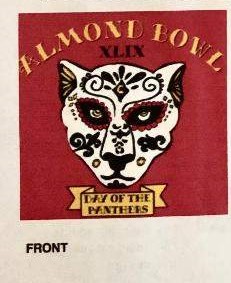
VOCES Latinxs at Chico High produced the winning design for the school’s Almond Bowl T-shirt that includes a sugar skull-like image.
On the surface, this story appears to be about a disagreement over the T-shirt design chosen to commemorate this year’s Almond Bowl, the cross-town football game that each fall marks athletic rivalry between two local high schools.
But beneath the surface, the story is really about how we, as individuals and a society, choose the symbols and imagery we find acceptable to represent ourselves to the rest of the world. And beyond that, it is about the divisions between whom we view as “us” and “them.”
Some background: Every year the Chico High School (CHS) Associated Student Body holds a design contest for the T-shirts and sweatshirts that students and fans wear to the big game against Pleasant Valley High School. This year’s game falls on Nov. 1, the traditional Mexican Day of the Dead. Given that coincidence, a club for Latino students called VOCES Latinxs came up with the idea of combining the school’s panther mascot with some typical Day of the Dead design touches. (In English, “voces” means “voices.”)read more
Tiny microbes can help addresses climate change - if we stop killing them
By Carina Merrick | Posted July 26, 2019
courtesy of Wikimedia Commons
Thomas Jefferson’s improved mouldboard plow.
When Europeans arrived in the Americas, they applied their mouldboard plows to the prairies, to soils that were rich, dark and black. That soil was steaming with mineral and organic carbon — with soil life so small it was invisible to the human naked (unmicroscoped) eye and, hence, to our consciousness. So we ripped into them with gusto, mining this flesh of earth.
The settler-farmers killed the microbes by exposing them to sunlight, erosion, heat and dryness, and they planted monocrops – a single crop like wheat. Or corn. Or walnuts.
The soil’s rich, dark color faded. The soil lost its carbon, its water, its oxygen. The rich, natural, complex collaborative ecologies were replaced by chemical fertilizers, pesticides, herbicides — inputs that continue to strip life from the thin surface of the planet.
We killed everything — plants, animals, insects, microbes. Each living thing other than our single crop was viewed as an enemy, a “competitor,” and we went to war with every tool at hand, stripping the soil of its naturally complex soup of collaborative dynamic life.read more